Writing - The Editing Process
Posted on March 25th 2027
Spoiler Warning:
This post is about my editing process. Any imagery or screenshots I've used to help illustrate this process will likely also contain snippets or excerpts of early drafts. If that doesn't bother you, feel free to read on.
“Find a nice quote about editing” - M.J.Thomas
There are lots of different types of editing and all of them are important, but the order in which you tackle each type of edit can save you a lot of time. After plenty of trial and error, working on the first book, this is the order in which I’ll be editing the rest of the series.
Editing Stages
1. Re-writing (optional)
2. Problem-solving
3. Structural
4. Line edits
5. Proof-reading
1. Re-writing (optional)
The earliest editing I find myself doing is almost indistinguishable from the original writing. I will re-write scenes, dialogue, and sentences as I go, often progressing a few paragraphs before stopping briefly to read back a little way and make changes.
This re-writing really improves the clarity and quality of my early drafts but does take more time. I know many writers try to avoid doing this before finishing their first draft.
But once I’ve got a complete draft, the real work can begin.
2. Problem-solving
At this point, I can read the story through from beginning to end but will almost certainly find a few issues. The biggest problems are contradictions or inconsistencies in the main plot, thin or nonexistant character motivations, and subplots that don’t support or even interact with the rest of the book. These will all need to be fixed.
The first place I go looking for potential solutions is the notes app on my phone.
Let me explain.
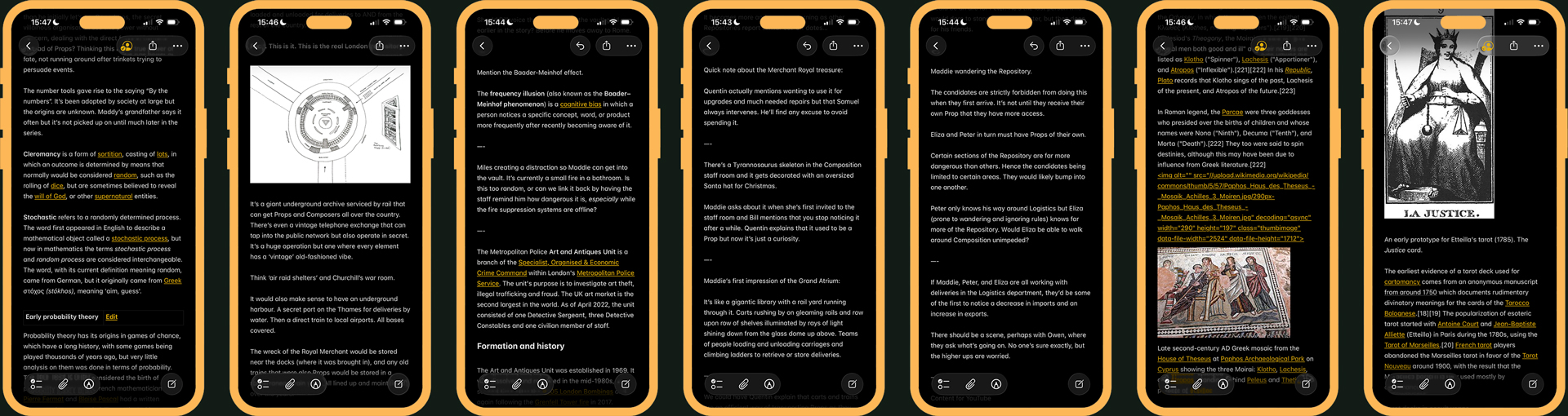
The notes app on my phone is the path of least resistance whenever I’m thinking about the series. I always have it with me and will write down ideas at any hour they occur to me (usually when I’m travelling somewhere, or at about 11pm as I’m trying to fall asleep).
Over time it’s become a kind of primordial soup where all of my thinking and re-thinking about the series happens. It contains research I haphazardly paste in, reminders of tropes or scenes I love in other works, and even draft dialogue and scene descriptions.
Typical examples include:
"Trinity College Library - They had to raise the roof at one point to store more books. The London Repository just dug further down."
"The Carpathia's captain, Arthur Rostron (good name)."
"Is there an international ranking between Repositories?"
"Wait. There's an actual abandoned Tube station under the British Museum?!"
I make a point of revisiting these notes any time I’m in need of an idea or solution. It never fails to remind me of some interesting detail or research I can use to solve a problem. For this reason alone I’d recommend anyone thinking of writing a book to make copious notes, in whatever way works best for you.
3. Structural
The process of solving any major problems will usually result in new scenes, new conversations, extra writing. It’s mostly additive and this can cause structural issues.
Adding lots of new scenes to the first half of the book can push your midpoint further and further towards the back of your draft. Certain chapters may become two or three times larger than your average chapter length. Pacing issues might start to appear.
Sometimes it helps to get a ‘birds eye view’ of your manuscript, to help highlight any areas of concern. Is my midpoint roughly in the middle? Yes? Phew!
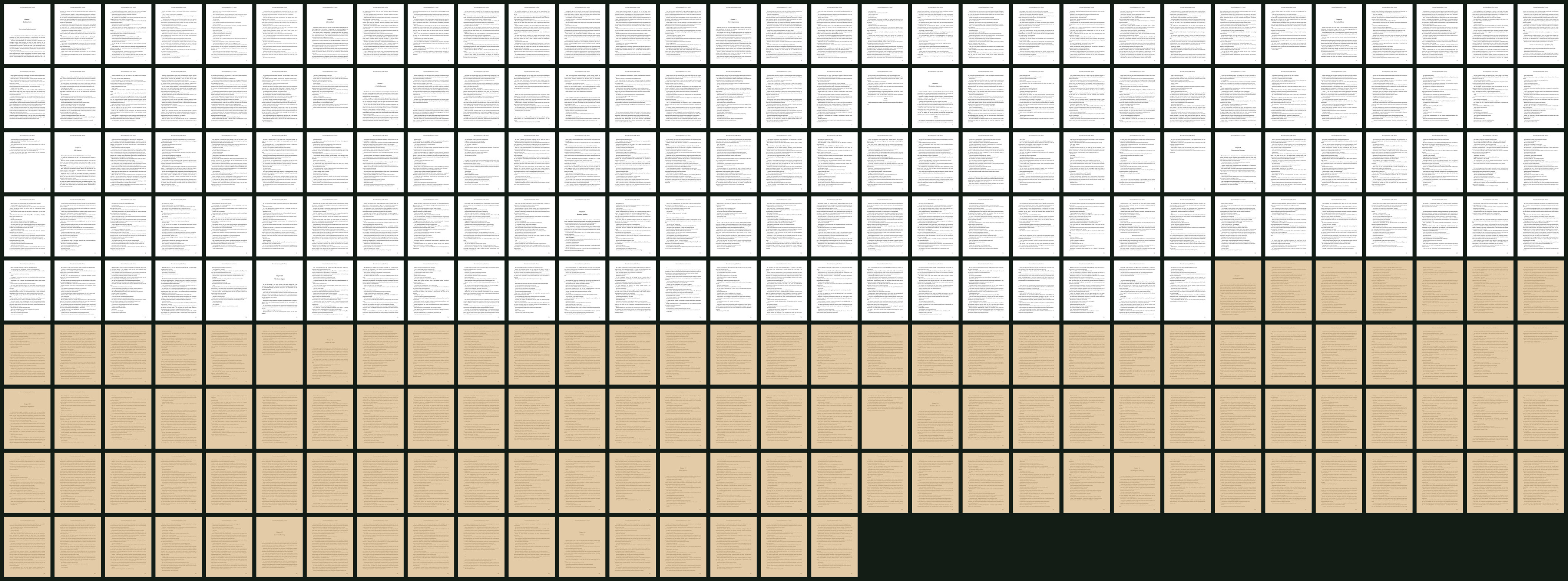
“Is this subplot/scene extraneous? Can I cut it?”
“What if I split this overly long chapter into two?”
“Ah, I have two action scenes back-to-back now.”
“Hey, I can save this reveal until later for twice the impact!”
Fixing structural issues is largely refining what you’ve got on the page. Making sure you haven’t strayed too far from your outline and that most of your chapters are roughly the same length. Once the structural edit has been completed, things get interesting.
4. Line Edits
If you’ve solved all your major problems and taken care of any structural issues, your draft should be in pretty good shape. This next edit is where we really polish things up. Of all the different stages, I find this one takes me the most time.
Line editing focuses on the writing style. Finding turns of phrase you use too often, or rely on too heavily (I have plenty of these). Replacing adverbs with better alternatives. Overuse of qualifiers. Killing your darlings, etc.
I like to think of these edits as ‘smoothing out any rough edges’ in your prose. Reducing the chance of a reader ‘tripping up’ over anything as they read. For this reason I like to make comments on my draft as I read through, noting anything that stands out.
You can see a few examples of comments in the screenshot below. This is pretty much what I’m looking at for months on end as I’m working on a book.
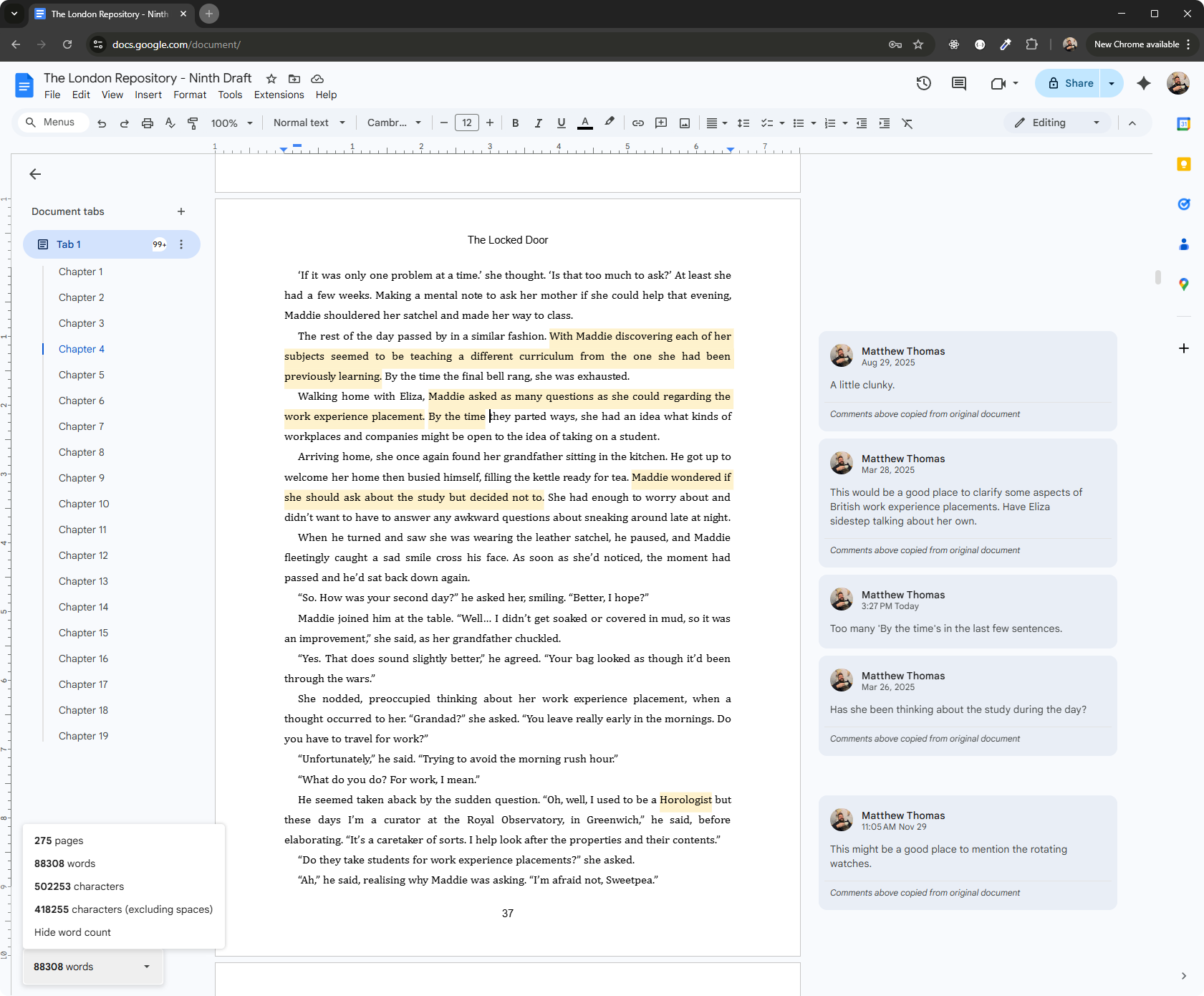
At certain points in the writing process it’s useful to know what my word count is. However, most of the time it’s nothing more than a distraction so I keep it hidden.
If you’re feeling confident, this is a good time to ask friends or family for early feedback. The more eyes you have on the manuscript, the more likely it is you’ll catch things that need fixing or could be improved upon. The goal is to get through your manuscript, from beginning to end, without ‘tripping up’ over anything.
5. Proof-reading
If you haven’t already, here’s where I’d advise printing off a paper copy of your manuscript (or putting it on an e-reader). Many writers and editors agree it can be helpful to see your work in a different format when proofreading. Spelling and grammar mistakes are easy to miss when you’re scrolling back and forth, focusing on bigger problems.
Invest in a nice red pen. You’ll need it.
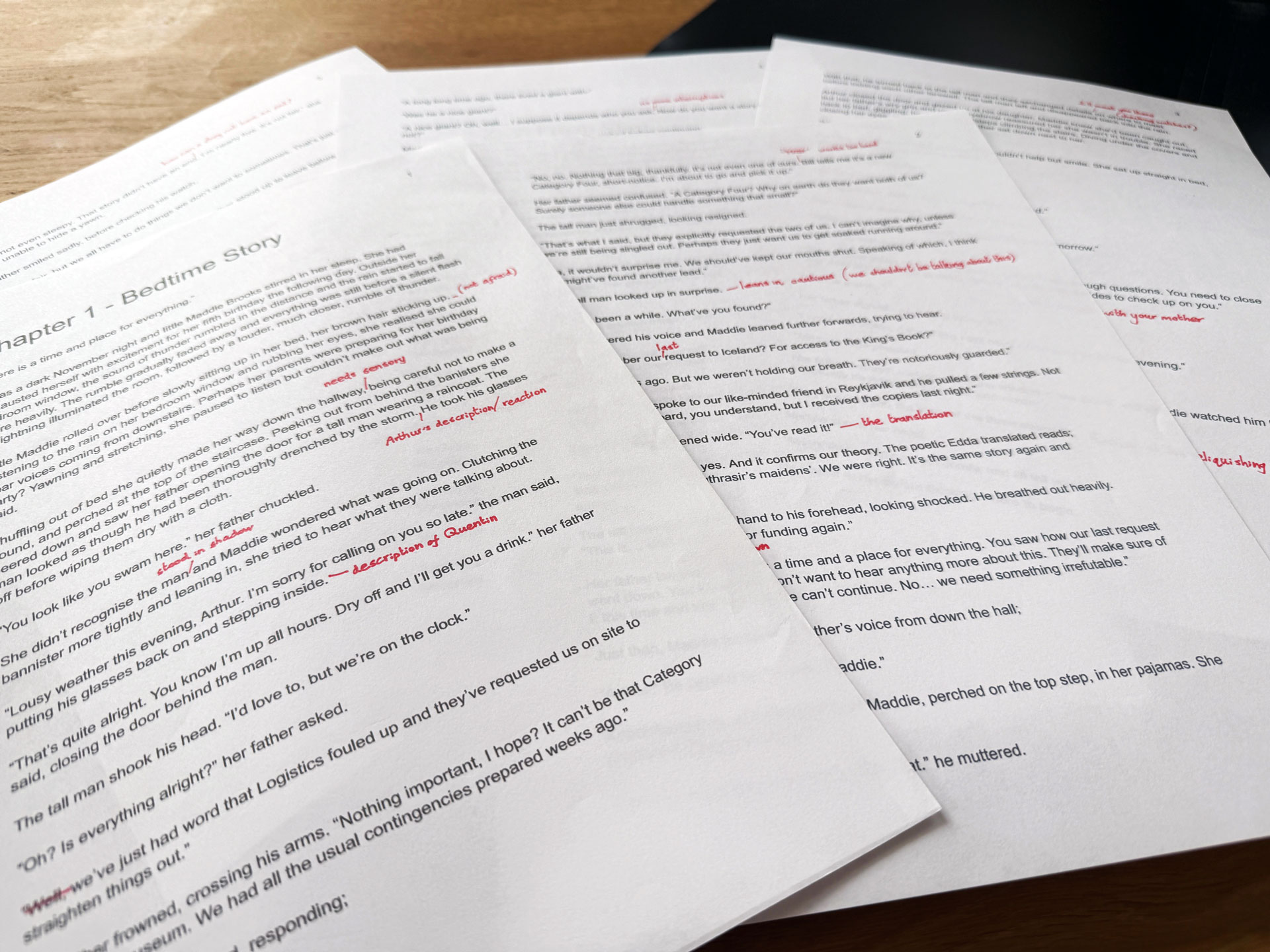
There’s nothing worse than not noticing a typo until it’s too late…
… except perhaps the knowledge that you’ll likely have to revisit each stage of this editing process several times before you finally have a manuscript ready for submission.
It’s true. Unfortunately.
Even editing in this streamlined and efficient manner, one pass will never be enough. To make your manuscript truly shine you should be prepared to polish it over and over again. It’s an intimidating process but bit by bit, you’ll find fewer and fewer issues.
Something I’ve found that helps with each round of edits, is to summarise my own comments and those of others in a small notebook. You can’t fit very much on a two-page spread so it serves two main purposes:
1. The amount of edits is less intimidating.
2. It makes my priorities more obvious.
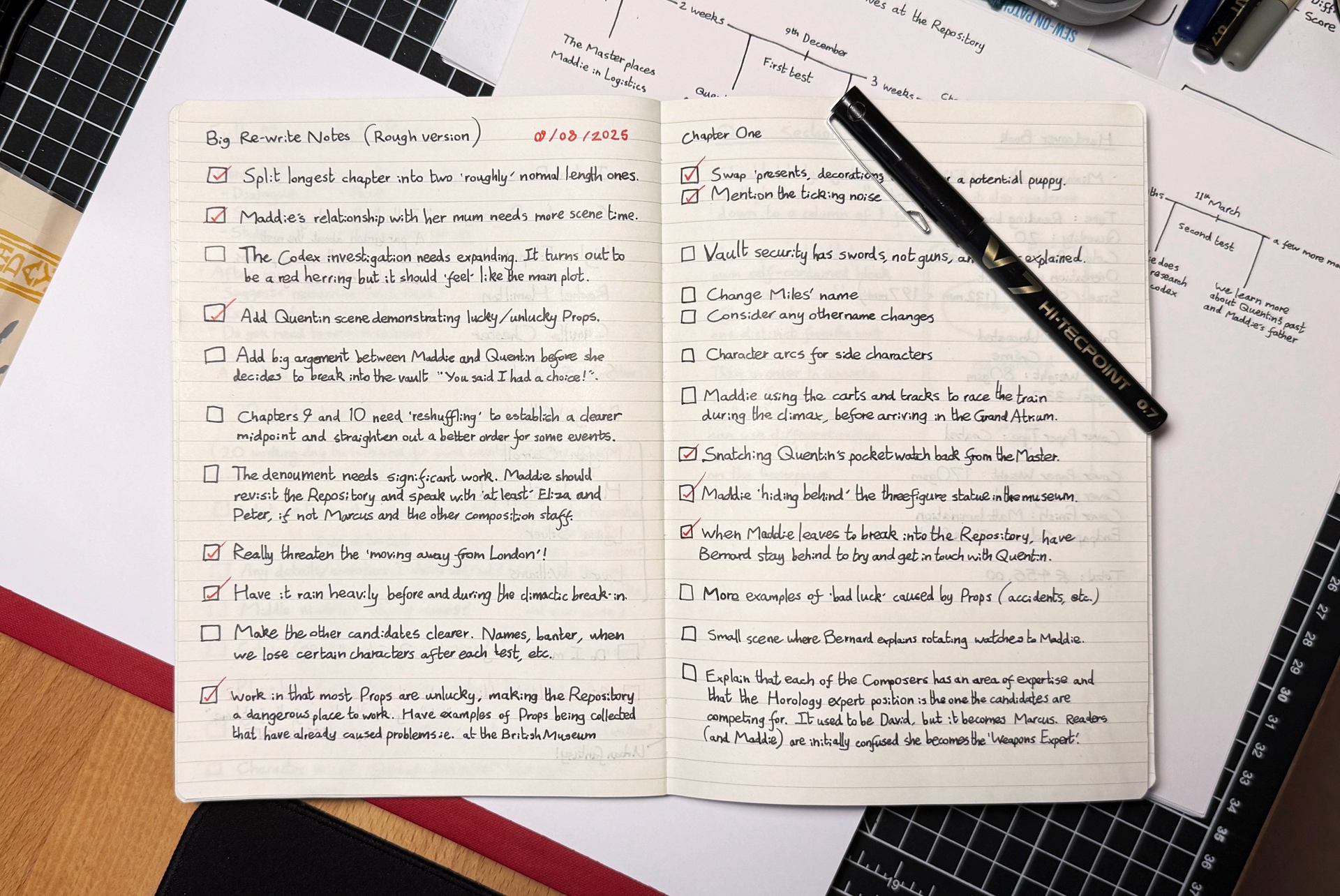
Tick things off one by one and eventually you’ll have a manuscript that people can’t put down. A story everyone’s talking about. Maybe even one that goes all the way.
Hopefully this breakdown of my editing process has proven interesting or helpful to you. Check the rest of my articles on writing if you’re looking for more advice and, if you’re working on your own book, keep going. It’ll be worth it. I promise.
